AI Video Scene Generation: Build Better Stories


AI Video Scene Generation is changing how ecommerce brands turn product visuals into engaging stories that communicate not only what a product looks like, but also why customers should care about it.
A product video can show what something looks like, but a good product story can explain why someone should care. That distinction is becoming increasingly important for ecommerce brands as customers are exposed to thousands of product images, advertisements, Reels, short videos, and promotional messages every day.
Simply showing a product on screen is often not enough to capture attention or communicate its value, which means brands increasingly need to think beyond individual visuals and create connected stories that guide customers through the product experience.
A fashion product might need an opening scene that introduces the collection, followed by model presentation, close-up details, styling moments, and a final purchase message, while a skincare product might require scenes showing the product, texture, application, benefits, and final result.
Similarly, a consumer electronics product may need an introduction, feature demonstration, real-world use case, close-up detail, and final benefit statement so customers can understand both the product and the value it provides.
This is where AI Video Scene Generation becomes valuable, because instead of treating AI video as one long generated clip, brands can think in terms of individual scenes that work together to communicate a complete product story.
By planning and generating scenes around specific storytelling objectives, ecommerce teams can create more structured videos that are easier to adapt for product pages, advertisements, social media, Reels, campaigns, and other marketing channels.
Why Product Videos Need More Than a Product Shot
A static product image primarily answers one question: what does the product look like? A product video has the opportunity to answer much more. It can explain what the product is, what problem it solves, how it works, what it looks like in use, what makes it different, who it is designed for, and why a customer should consider buying it.
Trying to communicate all of these points within a single visual moment can make a video feel crowded and difficult to follow. Scene-based video creation provides a more organized approach because each scene can focus on one part of the story.
For example, the opening scene can introduce the product and capture attention. The next scene can highlight an important feature, followed by a scene showing the product in context. Another scene can communicate the main customer benefit, while the final scene can present the campaign message or CTA.
This structure makes the video feel more like a story and less like a moving product photograph.
Moving from Video Generation to Video Storytelling
One of the common mistakes businesses make with AI video is starting with the question, “What video should we generate?” A better starting point is, “What story should this video tell?”
The difference may seem small, but it changes the entire production process. Video generation focuses primarily on producing footage, while video storytelling focuses on communicating an idea through a sequence of visual moments.
For an ecommerce brand, that idea might be that a product solves a specific customer problem. It could also communicate that the product belongs in a particular lifestyle, simplifies an everyday activity, offers a specific benefit, or represents a new collection worth discovering.
Once the central story is clear, deciding what each scene should show becomes much easier. The video is no longer a collection of attractive clips. Instead, every visual contributes to the same message.
What AI Video Scene Generation Means for Ecommerce
AI video scene generation involves creating individual visual moments that can be combined into a larger product story. Each scene can have its own composition, product position, camera movement, background, motion, marketing message, timing, and transition.
This approach makes the video easier to plan because every scene has a defined responsibility. It also makes the final content easier to adapt when a brand needs to change a particular feature, message, CTA, or visual direction.
A simple ecommerce product story might move from a product introduction to a feature highlight, then to lifestyle context, product demonstration, customer benefit, and finally a clear CTA. The structure can remain consistent across products while the actual visuals change according to the product category and campaign objective.
How to Build an AI Product Story Scene by Scene
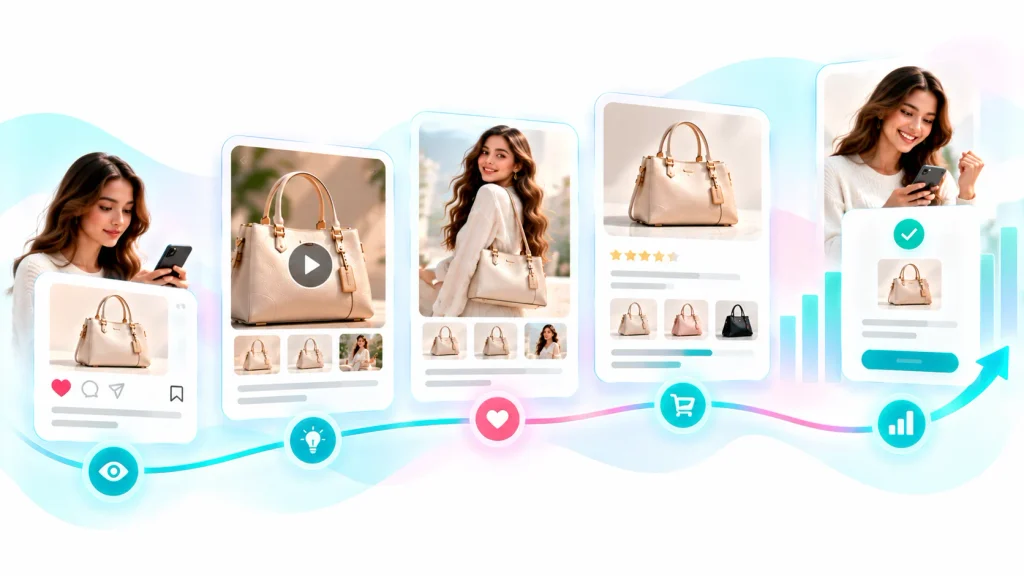
A strong AI product video usually begins with a clear narrative structure. Instead of immediately generating visuals, businesses should first decide what they want the viewer to understand and then divide that message into meaningful scenes.
Start with a Strong Opening Scene
The opening scene has an important responsibility because it needs to give viewers a reason to continue watching. The visual should communicate the subject quickly while creating enough interest to encourage the next few seconds of attention.
- For a fashion brand, this might be a visually striking product reveal or model presentation.
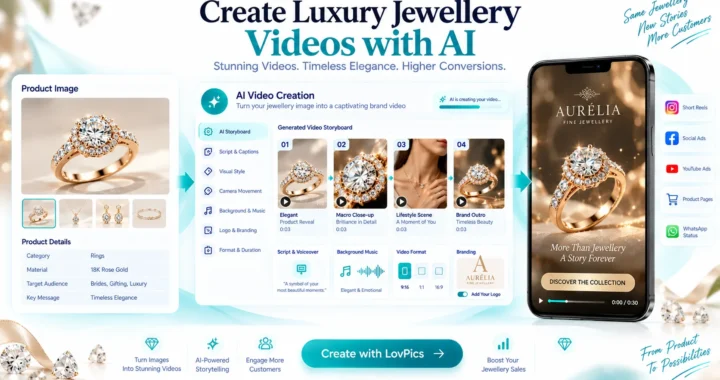
- For jewellery, it could be a premium close-up that emphasizes detail and craftsmanship.
- For food, the opening might focus on an appetizing presentation, while an electronics brand could use a dramatic product reveal.
The opening does not need to explain everything. Its primary purpose is to establish the subject and create curiosity.
Introduce the Product Clearly
After capturing attention, the next scene should make the product easy to understand. The viewer should be able to identify what is being presented without unnecessary visual distractions.
This could involve a clean product presentation, a model wearing the product, or a carefully composed product shot. The camera movement should support the product rather than make the scene unnecessarily complicated.
A clear product introduction gives the viewer a visual reference that makes the following scenes easier to understand.
Highlight an Important Feature
The next scene can focus on something that makes the product useful or different. Depending on the category, this could be the material, design, function, packaging, texture, technology, size, or another important detail.
The objective is not simply to change the camera angle. The scene should communicate something meaningful about the product.
For example, a fashion brand could focus on fabric texture or garment detailing. An electronics brand could demonstrate a specific feature, while a beauty brand could highlight product texture or application.
Show the Product in Context
Customers often understand products more easily when they can imagine themselves using them. This is where lifestyle storytelling becomes particularly useful.
A fashion product can be shown in a styled environment. A home product can appear inside a realistic room. A beauty product can be presented within a personal-care routine, while a travel product can appear within a relevant travel setting.
Context transforms the product from an isolated object into something that belongs within a real customer experience.
Communicate the Customer Benefit
Once the product and its features have been introduced, the story should answer an important customer question: Why does this matter to me?
The visual should support the benefit being communicated rather than simply showing another product shot. Where appropriate, the scene can demonstrate the outcome, use case, or experience associated with the product.
This is the point where the story moves from product information toward customer value.
Finish with a Clear CTA
The final scene should give the viewer a clear next step. Depending on the campaign, the CTA might encourage the customer to shop now, discover a collection, learn more, explore the product, place an order, view additional details, or get started.
A strong ending gives the video direction and prevents it from feeling incomplete.
How to Plan Better AI Video Scenes
AI generation becomes more effective when every scene has a clear role. Before generating a scene, businesses should define five important elements: its purpose, the product focus, the environment, the intended motion, and the transition into the next scene.
For example, suppose the goal is to highlight premium fabric on a fashion product. The product focus would be the fabric texture and garment detail, the environment could be a minimal luxury studio, and the motion might be a slow camera push-in. The transition could then move naturally from the close-up into a lifestyle scene.
This type of planning provides much stronger creative direction than simply asking AI to create a beautiful product video.
Choosing the Right Scene Structure for Different Products
Different products require different storytelling approaches. The same scene structure should not be applied mechanically to every category.
Fashion Products
Fashion videos can combine model introductions, full-body presentations, multiple poses, fabric close-ups, lifestyle scenes, collection transitions, styling moments, and a final collection CTA.
The story should help viewers understand both the product and the lifestyle associated with it. A fashion video should therefore balance product visibility with visual atmosphere and styling.
Jewellery
Jewellery benefits from detail-oriented scenes because customers often need to see the product closely before they can appreciate its design.
A possible story could move from a luxury introduction to a product close-up, detailed movement, worn presentation, and a final CTA. The visual treatment should remain refined and premium throughout the sequence.
Beauty and Skincare
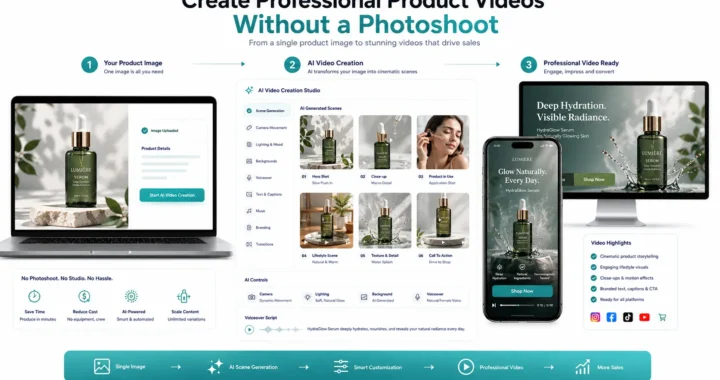
A skincare story can follow a progression such as product reveal, texture, application, routine, benefit, and CTA.
This structure gives the brand an opportunity to combine visual appeal with product education. Instead of simply displaying the packaging, the video can help customers understand how the product fits into their routine.
Electronics
For electronics, scene-based storytelling can be useful for explaining functionality. A video might introduce the product, show an important design detail, demonstrate a feature, present the product in a real-world setting, and then communicate the benefit.
This helps customers understand more than the physical appearance of the device.
Food and Beverage
Food videos can focus heavily on visual appeal and product experience. A sequence might introduce the product, highlight texture, show preparation or presentation, move into a serving moment, and finish with a close-up and CTA.
The objective is to create appetite while communicating what makes the product appealing.
Home and Furniture
Furniture benefits from context because customers need to imagine how a product might look within their own space. Instead of showing only the furniture against a blank background, scenes can introduce the product, place it within a room, highlight important details, show lifestyle use, and finish with a wider room presentation and CTA.
This makes the product easier to visualize in a real environment.
How Businesses Can Scale AI Video Scene Generation
The real value of scene generation becomes more apparent when brands use the approach repeatedly. Creating one successful product story is useful, but building a repeatable system can make the process much more valuable.
Build Reusable Story Structures
Brands do not need to invent an entirely new narrative for every product. A repeatable structure such as Hook, Product, Feature, Use Case, Benefit, CTA can provide a reliable starting point.
The actual visuals can then change according to the product, audience, campaign, and platform.
This allows teams to maintain consistency while still creating different stories.
Create a Scene Library
Brands can organize successful scenes according to their purpose. A scene library might include product reveals, feature close-ups, lifestyle moments, product demonstrations, collection introductions, offer scenes, and CTA endings.
Over time, these reusable creative patterns can accelerate video production and make it easier for teams to build new campaigns.
Create Multiple Story Versions
One product does not necessarily need only one story. A fashion product could have a product-focused version, a lifestyle-focused version, a promotional version, and a feature-focused version.
Creating different storytelling angles gives brands more opportunities to test what resonates with different audiences.
The important point is to create meaningful variation rather than producing several videos that look almost identical.
Adapt Scenes for Different Platforms
A product story created for a website may not work exactly the same way on social media. Short-form platforms generally require faster pacing and a stronger opening, while a product page may allow more time for explanation.
Brands should therefore adapt scene length, framing, text, pacing, and CTA according to the destination.
LovPics AI Video workflows support both 9:16 vertical and 16:9 landscape formats, allowing businesses to create content for different viewing environments.
Use Multiple Product References When Needed
Some products require more than one visual reference to communicate their details properly. A product might have separate front, back, detail, or packaging images.
Using multiple references can provide additional visual information when developing a sequence. LovPics AI Video Gen supports up to four clip images, with concepts generated per clip and combined video export.
Related LovPics AI Solutions
- AI Video Gen can create product-focused video scenes from visual references.
- Product Reels can turn product concepts into structured, multi-beat reels.
- AI Reels can create social-first short-form video content.
- UGC Product Showcase can combine products with creator-led storytelling.
- Voice-over Reels can add narration and structured marketing scripts.
- AI Fashion Studio can create fashion product references before video generation.
- AI Productshoot can create stronger product imagery to use as scene references.
- AI 360° View can create rotating product presentation experiences.
- AI Banners can extend video campaign concepts into static advertising.
- AI Posters can create supporting campaign assets using the same creative direction.
The advantage of connecting these capabilities is that the product does not need to be recreated from scratch for every content format. The same underlying product reference and creative direction can support multiple types of marketing content.
Real-World Applications of AI Video Scene Generation
Product Launch Stories
A new product launch needs more than a simple announcement. A structured video can introduce the product, reveal its design, demonstrate an important feature, explain its benefit, and finish with a launch CTA.
This creates a complete narrative rather than a simple product reveal.
Product Feature Videos
Some products have features that are difficult to communicate through static images. Scene-based videos allow brands to dedicate individual moments to important features, making complex information easier to understand.
This is particularly useful for products where functionality plays an important role in the purchase decision.
Social Media Reels
Short-form content needs a strong hook and clear pacing. Scene generation allows brands to intentionally structure the first few seconds instead of relying on one continuous clip.
A carefully planned sequence can create faster pacing while ensuring that every visual contributes to the message.
Paid Advertising
Advertising requires both attention and clarity. A product advertisement can follow a structure such as Hook, Problem, Product, Benefit, and CTA, with each stage represented through a different visual scene.
This makes it easier to align the creative with the advertising message.
Product Education
Some customers need more information before they feel confident making a purchase. Scene-based videos can explain how a product works, how to use it, what makes it different, which features matter, and who should use it.
This makes AI video useful for product education as well as direct advertising.
Seasonal Campaigns
Seasonal campaigns often require new creative directions. A reusable scene structure can be adapted for festival campaigns, holiday promotions, end-of-season sales, new collections, limited editions, and special offers.
The storytelling framework can remain consistent while the visual treatment changes according to the campaign.
Across the LovPics Ecosystem
AI video scene generation becomes even more powerful when it connects with the rest of the visual production workflow.
A product can begin with a product reference, become an AI product image or fashion shoot, move into scene planning, and then become an AI-generated video. That video can subsequently become a Product Reel, Banner, Poster, or broader campaign asset.
This creates a connected visual production system rather than a collection of disconnected content-generation activities.
Instead of producing every marketing asset independently, brands can reuse the same product references, concepts, creative direction, and campaign messaging across multiple formats.
Expand Product Stories with LovPics
The biggest opportunity is not simply generating more scenes. It is building a reusable storytelling system that allows brands to create different marketing assets from the same product foundation.
Consider a fashion product. The same product reference could support a collection introduction, full model presentation, fabric close-up, lifestyle presentation, styling moment, promotional message, and final CTA.
That creative direction could then be adapted into a Reel, advertisement, product-page video, social post, or campaign asset.
This makes each product reference more valuable because it becomes the starting point for multiple pieces of marketing content.
The goal is to move from one product creating one video toward one product supporting multiple stories and multiple marketing assets. That is where scene-based AI video production becomes particularly powerful.
Common Mistakes Businesses Make
Starting with Visuals Instead of the Story
Generating scenes before deciding what the video should communicate can produce attractive but disconnected footage. The visuals may look impressive, but the viewer may not understand how one scene relates to the next.
Better approach: Define the story first and then create scenes around the message.
Making Every Scene Look the Same
A product video can become monotonous when every scene uses the same framing, background, and movement. Visual consistency is important, but consistency should not mean repetition.
Better approach: Vary the visual treatment while maintaining a recognizable brand style.
Adding Too Many Scenes
More scenes do not automatically create a better story. Too many transitions can make a short video difficult to follow and can reduce the impact of the most important moments.
Better approach: Give every scene a specific purpose and remove scenes that do not contribute to the story.
Using Motion Without Meaning
Camera movement can look impressive while still failing to communicate anything useful. Movement should support the message rather than exist only for visual effect.
Better approach: Use movement to reveal, explain, emphasize, or transition between meaningful product moments.
Forgetting the Product
Some AI-generated scenes can become visually elaborate while the actual product becomes secondary. This defeats the purpose of product marketing.
Better approach: Keep the product central to the story and make sure the visual environment supports rather than overwhelms it.
Ignoring Product Accuracy
AI-generated visuals can sometimes introduce changes to product details, especially when the scene becomes complex.
Better approach: Compare important scenes with the original product reference before publishing the final video.
Treating the CTA as an Afterthought
A product story should lead somewhere. If the final scene does not provide a clear next step, the viewer may finish the video without knowing what to do.
Better approach: Decide the desired customer action before creating the final scene.
Creating Only One Version
A single creative may not work equally well for every audience, platform, or campaign objective.
Better approach: Create meaningful variations around hooks, features, storytelling angles, and CTAs, and evaluate which versions perform best.
The Future of AI Video Scene Generation
AI video is moving toward a more structured production model. Instead of generating isolated clips without a broader narrative, businesses can increasingly build complete visual stories from reusable scenes.
A product reference can become the foundation for multiple story structures. A single collection can support different narratives for different audiences, while a single campaign can use different hooks and creative angles.
This creates a much more flexible approach to video marketing.
The future is therefore not simply about generating longer AI videos. It is about generating better sequences of meaningful visual moments that help customers understand products and make purchasing decisions.
For ecommerce brands, this distinction matters because customers do not simply need to see products. They need to understand them, imagine using them, recognize their value, and eventually receive a reason to take action.
Well-planned AI video scenes can connect those steps into one coherent product story.
Comparison Table
| Factor | Traditional Product Video | AI Video Scene Generation |
|---|---|---|
| Story planning | Usually planned before production | Can be structured scene by scene |
| Physical shoot | Often required | Can begin with product references |
| Scene variations | Require additional production | Can be generated as variations |
| Background changes | Require set or location changes | Can be generated digitally |
| Creative testing | More expensive | Easier to test multiple concepts |
| Product references | Physical product and shoot | Product images or references |
| Scene flexibility | Limited by production setup | High creative flexibility |
| Platform adaptation | May require additional edits | Scenes can be adapted to different formats |
| Production scalability | Resource intensive | More scalable once workflow is established |
| Best use | High-end physical production | Product storytelling and scalable content |
Decision Matrix
| Marketing Requirement | Recommended Approach |
|---|---|
| Simple product showcase | Product Reel |
| Feature explanation | Scene-based AI video |
| Creator-led product story | UGC Product Showcase |
| Fashion collection story | AI Fashion Studio + AI Video |
| Product launch | Scene-based product story |
| Short social campaign | AI Reels |
| Narrated product education | Voice-over Reel |
| Product rotation | AI 360° View |
| Multiple campaign formats | AI Video + Reels + Banners |
| Large-scale product content | Reusable scene structures |
Frequently Asked Questions
What is AI Video Scene Generation?
AI Video Scene Generation is the process of creating individual AI-generated visual scenes that can be combined into a structured video story. Each scene can focus on a particular product detail, feature, use case, benefit, or marketing message.
Why use scenes instead of generating one complete video?
Scenes provide more control over storytelling because each scene can have a specific purpose, visual composition, product focus, movement, and message. This also makes it easier to change individual parts of a video without rebuilding the entire concept.
Can AI video scenes be created from product images?
Yes. Product images can be used as visual references for creating product-focused AI video content, allowing brands to turn existing product assets into dynamic marketing stories.
How many scenes should a product video have?
There is no universal number. A short social video may need only a few scenes, while a more educational product story may require additional moments. The important principle is that every scene should have a clear purpose.
Can I use different scenes for different product features?
Yes. Individual scenes can be structured around different features, benefits, product details, or use cases. This can make complex products easier for customers to understand.
Can AI video scenes be used for social media?
Yes. Scene-based storytelling can be particularly useful for short-form content because brands can intentionally structure hooks, product moments, feature highlights, and CTAs.
Can I create both vertical and landscape product videos?
Yes. LovPics AI Video Gen supports 9:16 vertical and 16:9 landscape output, allowing brands to adapt product stories for different viewing environments.
Can I use multiple product images?
Yes. LovPics AI Video Gen supports up to four clip images, allowing multiple product references to contribute to the video workflow.
Can AI video scenes include music and subtitles?
Yes. LovPics video workflows support background music and subtitle capabilities, depending on the workflow being used.
Can I add branding to the final product story?
Yes. LovPics supports logo overlays and branded outro cards within its AI video workflow.
Should every scene have a different background?
No. Consistency is important. Background changes should support the story rather than simply create visual variety. A consistent visual language can help the final video feel more professional and connected.
How can I make AI product videos more engaging?
Start with a strong hook, give every scene a clear purpose, use meaningful visual movement, highlight important product benefits, maintain product accuracy, and finish with a relevant CTA. The strongest results come from storytelling rather than simply generating visually attractive clips.
Conclusion
AI video scene generation changes the way brands can approach product storytelling. Instead of thinking about a product video as one continuous piece of generated footage, businesses can break the story into meaningful visual moments that each contribute to the overall message.
A strong product story might move from a hook to the product, feature, context, benefit, and CTA. Each scene has a defined purpose, making the final video easier to plan, adapt, and reuse across different marketing channels.
For ecommerce brands, the biggest opportunity is not simply creating more AI videos. It is creating better product stories from the same underlying product references.
One product can support multiple scenes, and multiple scenes can create different stories for different audiences and campaigns. Those stories can then become Reels, advertisements, product videos, campaign assets, and other marketing content.
That is the real potential of AI Video Scene Generation: turning product references into structured, purposeful stories that help customers understand products, imagine using them, recognize their value, and take action.