AI Product Photography for UAE E-commerce Brands


UAE E-commerce Brands: The Growing Need for Quality Product Photography
UAE E-commerce Brands operate in a highly competitive digital market where customers discover and purchase products through online marketplaces, brand websites, social media channels, and mobile shopping platforms. From fashion and beauty to electronics, jewellery, home decor, and consumer goods, businesses need to present their products clearly and professionally across multiple digital touchpoints to attract customers and build purchase confidence.
Why Product Photography Matters for UAE E-commerce
Product photography plays a major role in this process because customers cannot physically inspect most products before ordering online. Images help shoppers understand a product’s appearance, design, size, material, packaging, and possible uses, making high-quality visuals an important part of the buying experience. While strong product images can make a listing more informative and appealing, inconsistent or unclear photography can make even a good product difficult to evaluate.
The Challenges of Traditional Product Photography
However, producing professional product images for every item can become expensive and time-consuming, particularly when businesses need studio arrangements, photographers, models, lighting, props, editing, and repeated photoshoots whenever new products or collections are introduced. This challenge becomes even more noticeable for ecommerce brands managing large catalogs or selling across several platforms.
How AI Product Photography Helps UAE E-commerce Brands
AI Product Photography for UAE E-commerce Brands offers another way to approach this requirement by allowing businesses to use existing product photographs and visual references to create different product presentations, lifestyle scenes, fashion images, and promotional visuals through AI-assisted workflows. Instead of treating every image as a separate production project, teams can establish a more repeatable process for preparing product content while reducing repetitive production work.
For UAE businesses, this approach can support content creation across local ecommerce stores, Amazon.ae, noon, social commerce platforms, and regional marketing campaigns. However, businesses need to understand where AI-generated imagery is appropriate, how to maintain product accuracy, and how to prepare visuals according to the requirements of each marketplace and sales channel.
Create Ecommerce Visuals with LovPics
LovPics brings together AI Productshoot, AI Fashion Photoshoot, E-commerce Pack, AI Retouch, AI 360° View, and other visual creation capabilities to help businesses prepare product-focused content for different ecommerce and marketing requirements. By connecting these capabilities within one creative workflow, brands can develop more consistent product visuals and support their growing digital commerce activities.
Why Product Photography Matters for UAE E-commerce Businesses
The UAE ecommerce market reached AED 42.2 billion in 2025, according to a report announced by Emirates News Agency. The report also identifies apparel and footwear as the largest ecommerce vertical, followed by consumer electronics and home care. This creates opportunities for businesses across several product categories, but it also increases the importance of presenting products effectively online.
Customers browsing an online store often compare several products before making a decision. They may look at the main product photograph first, then examine additional angles, details, lifestyle images, and product information. If the visual presentation does not answer their questions, they may move to another listing.
Customers Depend on Product Images Before Buying
Online shoppers cannot touch a fabric, inspect a jewellery finish, test an electronic device, or examine furniture dimensions through a screen. Product photography helps bridge this gap by showing the item from useful angles and providing visual context.
For example, a fashion customer may want to understand the garment’s fit, color, texture, and styling. Someone purchasing furniture may need to see the product within a room setting, while a beauty customer may want to inspect the packaging and product texture.
Competition Requires Consistent Product Presentation
UAE businesses often sell through several channels, including their own ecommerce websites and third-party marketplaces. Each channel creates different presentation requirements, but the brand should still maintain a recognizable visual identity.
Consistent lighting, accurate product colors, clean backgrounds, and well-organized product images help create a professional catalog. This becomes particularly important when a business introduces new products frequently.
Product Images Support More Than Marketplace Listings
Product photography is not limited to the main ecommerce listing. The same product may need images for social media posts, paid advertisements, promotional banners, email campaigns, collection pages, and seasonal marketing.
A business that prepares only one basic product photograph may need to arrange additional creative production later. Planning different image requirements together can make the overall content workflow more efficient.
The Challenges of Traditional Product Photography in the UAE
Traditional photography remains valuable, particularly when businesses require precise physical representation, specialized lighting, complex sets, or a controlled commercial shoot. However, managing repeated production for a large ecommerce catalog can create operational challenges.
Studio and Production Costs
A traditional product shoot may involve a studio, photography equipment, lighting, backdrops, props, photographers, assistants, models, and editing. The cost depends on the product category, production complexity, number of images, and creative requirements.
Fashion and jewellery businesses may need additional preparation because garments, accessories, models, styling, and product details require careful handling. For a business launching new collections regularly, repeated production can become a significant expense.
Time Required to Prepare Product Images
A product photography project involves more than taking photographs. Products need to be prepared, arranged, photographed, reviewed, edited, and approved. If a business needs several angles, backgrounds, or campaign variations, the production timeline can increase.
This can make it difficult to prepare large volumes of images quickly, particularly when new products arrive close to a campaign date.
Managing Large Product Catalogs
A business with hundreds of products may need multiple images for each item. If every product requires a separate production process, maintaining the catalog becomes difficult.
The challenge is not only creating the first image. Businesses also need to prepare new variants, update older images, maintain consistent presentation, and produce promotional content throughout the year.
Maintaining Visual Consistency Across Channels
A product may appear on a website, marketplace, Instagram account, advertisement, and promotional banner. If every asset is produced independently, the lighting, backgrounds, image style, and overall presentation may vary.
Maintaining a consistent visual direction requires clear brand references and an organized content process.
What Is AI Product Photography?
AI product photography uses artificial intelligence to create, enhance, or transform product images using product photographs, reference images, and creative instructions.
Instead of arranging a traditional shoot for every visual requirement, businesses can provide an existing product image and use AI tools to generate different presentations. Depending on the capability and the source material, this may include background changes, studio-style settings, lifestyle scenes, product-focused compositions, fashion imagery, or marketing creatives.
For example, an ecommerce seller may start with a photograph of a handbag. The same product reference can support a clean product presentation, a lifestyle scene, a close-up detail image, and a promotional visual.
AI product photography does not mean that every generated image is automatically suitable for every purpose. Marketplace main images, lifestyle photographs, and advertising creatives have different requirements. Businesses must review the result and make sure that the product remains accurately represented.
How AI Product Photography Works for UAE Businesses
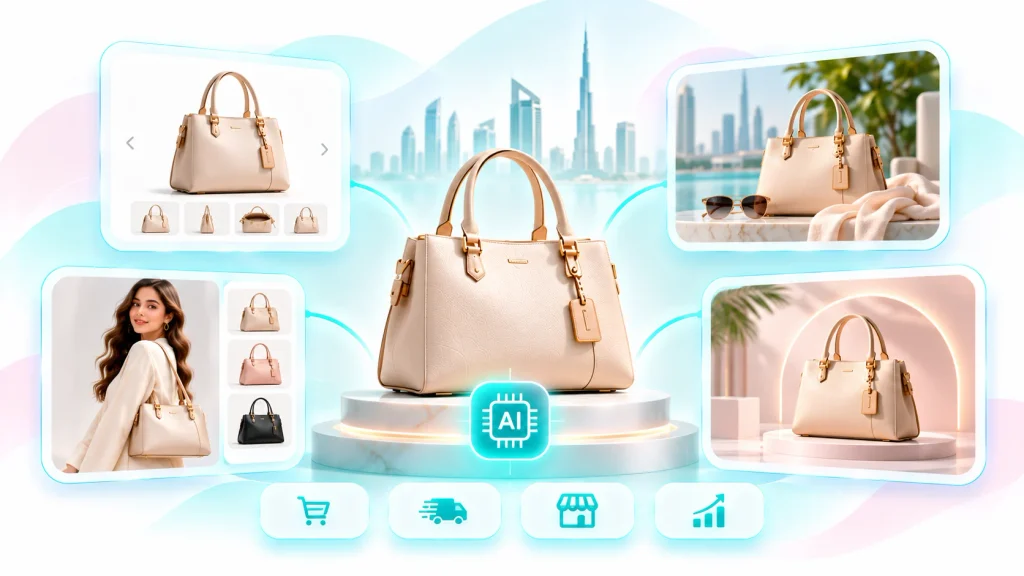
AI product photography becomes more useful when businesses treat it as a repeatable content workflow rather than a one-time image-generation activity.
Step 1: Select a Clear Product Reference
Begin with a good photograph of the actual product. The product should be visible, properly exposed, and sufficiently detailed for the intended image transformation.
Useful reference images may include a front view, back view, side view, packaging photograph, close-up detail, or product-in-use image. The type of reference depends on the product and the final image requirement.
Step 2: Decide the Purpose of the Image
Before generating an image, decide where it will be used. A marketplace main image has different requirements from a lifestyle photograph or social media advertisement.
Common image requirements include:
- Main product listing image
- Additional product angles
- Lifestyle product photography
- Product detail images
- Fashion catalog photography
- Product comparison visuals
- Promotional creatives
- Social media images
- Collection and campaign images
The purpose should guide the background, composition, lighting, framing, and visual treatment.
Step 3: Choose the Desired Background and Setting
Background selection can change how a product is presented. A plain background may be suitable for a marketplace main image, while a lifestyle setting can help customers understand the product in context.
A premium skincare product might be shown in a clean studio environment, while a furniture product may benefit from an interior setting. A fashion product may require a model-based presentation or a suitable editorial background.
Step 4: Define the Lighting and Composition
Lighting influences how customers perceive product materials, colors, textures, and details. Creative instructions should describe whether the image needs soft studio lighting, subtle shadows, a bright clean background, or a more atmospheric lifestyle presentation.
Composition should keep the product easy to identify. Avoid unnecessary decorative elements that distract from the product or create confusion about what is included in the purchase.
Step 5: Generate and Review the Image
Generate the image using the chosen product reference and creative direction. Review the output against the original product before using it in a listing or campaign.
Check the product shape, proportions, color, texture, logo, labels, packaging, and included accessories. If the generated result changes an important product detail, regenerate or correct the image rather than publishing an inaccurate representation.
Step 6: Prepare Images for Different Channels
Once the product visuals are approved, prepare suitable versions for the intended destinations. A marketplace listing may require a clean main image and additional product views, while social media may need a more expressive creative.
Organize the final assets by product, SKU, channel, image type, and campaign. This makes it easier to reuse approved images and maintain consistency across future updates.
AI Product Photography for Amazon.ae and noon
UAE ecommerce businesses selling through marketplaces should understand that marketplace image rules are not the same as general marketing design preferences. A visually attractive image may still be unsuitable as a primary listing image if it does not follow the platform’s requirements.
Amazon.ae Product Image Requirements
Amazon UAE’s product image guidance requires the main image to represent the actual product accurately and use a pure white background. Its guidance also specifies that the product should occupy approximately 85% of the image, remain fully visible, and not be presented with unrelated props or accessories.
Amazon’s UAE product image guide recommends adding multiple supporting images and a video to help customers evaluate products. The exact technical and visual requirements can vary by category, so sellers should review the latest category-specific guidance before uploading.
For AI-assisted workflows, this means businesses should distinguish between the main listing image and additional lifestyle or feature images. A generated lifestyle scene may be useful as a secondary image or advertising asset, but it should not automatically replace a compliant main image.
noon Product Image Requirements
noon’s seller guidance recommends using multiple high-quality images to help customers understand the product. Its image requirements include product views, a pure white background for primary images in most categories, and category-specific presentation rules. Fashion products have different background recommendations from many other categories.
The guidance also highlights useful supporting details such as different product angles, sizes, textures, and fabrics. These are particularly relevant for fashion, home, and consumer product listings.
Businesses using AI should review the latest noon requirements for their specific product category and seller SKU before publishing generated images.
Build Separate Marketplace and Marketing Image Sets
A practical approach is to prepare two connected image groups.
Marketplace image set:
- Compliant primary product image
- Additional product angles
- Close-up details
- Size or dimension references where permitted
- Product-specific supporting images
Marketing image set:
- Lifestyle product photographs
- Promotional creatives
- Social media images
- Campaign banners
- Collection visuals
- Seasonal product presentations
This approach helps businesses maintain marketplace compliance while still developing creative visuals for brand marketing.
How UAE E-commerce Brands Can Use AI Product Photography
Fashion and Apparel Brands
Fashion and apparel represent an important ecommerce category in the UAE. Brands selling clothing, modest fashion, abayas, dresses, footwear, and accessories need consistent product photography across collections and variants.
AI-assisted fashion photography can help create model-based product presentations, different poses, styling concepts, and catalog visuals. Businesses should still verify garment details, fabric appearance, fit, and color accuracy before publishing.
Jewellery Businesses
Jewellery photography requires careful attention to product details, material appearance, stones, settings, and finish. AI can help create premium visual presentations and supporting lifestyle imagery, but generated results must preserve the actual jewellery design.
For marketplace listings, businesses should keep the primary product image aligned with the relevant platform’s rules. More creative backgrounds and campaign compositions can be used for suitable secondary or promotional content.
Beauty and Skincare Brands
Beauty businesses can use product photography to present packaging, bottles, jars, product texture, and collection ranges. Lifestyle scenes can support brand storytelling, while close-up product images can help customers inspect packaging and presentation.
Any claims about ingredients, performance, benefits, or results should be supported by approved product information. AI-generated visuals should not introduce claims or product characteristics that the business cannot verify.
Electronics and Gadgets
Electronics sellers often need images that communicate product design, ports, buttons, accessories, dimensions, and included components. AI-assisted workflows can help create clean presentations and contextual scenes, but they should not alter the device’s actual specifications or appearance.
Home Decor and Furniture
Furniture and home decor products benefit from both clean product images and lifestyle settings. A chair, lamp, table, or decorative item may be easier to understand when shown in a relevant interior environment.
AI lifestyle photography can help businesses explore different room styles and visual settings. However, scale, dimensions, color, materials, and included items should remain accurate.
Food and Beverage Products
Food and beverage brands can use product photography to present packaging, serving suggestions, product ranges, and campaign visuals. A clean product image may support an ecommerce listing, while lifestyle and serving scenes can be useful for social media and promotions.
Generated visuals should not misrepresent the quantity, ingredients, packaging, or actual product being sold.
Creating Product Images for UAE’s Multilingual Audience
The UAE serves a diverse customer base, and businesses may communicate with customers in English, Arabic, and other languages depending on their audience and channel.
Product photography can support this communication through clear visuals, while campaign creatives may need localized text and messaging. A brand could use the same approved product image in an English campaign and an Arabic campaign while adapting the promotional message and layout.
For example, a fashion retailer may create product images for an English-language website and separate Arabic promotional creatives for a regional campaign. A beauty brand may use consistent product photography while adapting campaign copy for different customer segments.
The important distinction is between the product image and the text added around it. The product itself should remain accurate, while localized text, labels, and promotional claims should be reviewed by someone familiar with the language and market.
Seasonal Product Photography Opportunities in the UAE
Seasonal campaigns create recurring demand for new product visuals. UAE businesses can plan their photography around relevant shopping periods, promotional events, and customer occasions.
Ramadan and Eid Campaigns
Ramadan and Eid are important campaign periods for many retail categories. Fashion, gifting, beauty, food, home decor, and lifestyle businesses may prepare themed product visuals, gift collections, and promotional creatives.
AI product photography can help brands explore campaign backgrounds and product arrangements. Cultural references should be used thoughtfully and should match the brand’s audience and actual campaign.
White Friday and Major Shopping Promotions
White Friday campaigns can require large volumes of product images, promotional banners, and social media creatives. Businesses may need different visuals for featured products, bundles, discounts, and category promotions.
The product image should remain clear, while any offer text and pricing should be added and checked separately according to the destination’s requirements.
UAE National Day Campaigns
Businesses may prepare special campaign visuals around UAE National Day. Product photography can be adapted with suitable brand-led themes and supporting promotional assets.
Any use of national symbols, flags, or official imagery should be respectful and appropriate to the campaign.
Summer and Travel Campaigns
Seasonal changes can create opportunities for travel products, fashion, beauty, outdoor products, and lifestyle collections. Businesses can use relevant lifestyle scenes to show products in a context that fits the campaign.
How AI Product Photography Helps Businesses Scale
The value of AI product photography becomes more significant when businesses need to create and maintain visuals across large catalogs.
Create Multiple Visuals from One Product Reference
One approved product photograph can serve as the starting point for several image requirements. A business may create a clean product presentation, a lifestyle image, a close-up composition, and a promotional creative.
This does not mean every output should be used in every channel. Each image should be reviewed and assigned to the appropriate purpose.
Maintain a Consistent Brand Look
Businesses can establish visual references for backgrounds, lighting, colors, framing, and product presentation. Reusing these references can help different products look like part of the same collection.
Prepare New Collections More Efficiently
Fashion, beauty, and home brands often introduce new products or variants. A repeatable workflow can help teams prepare catalog and marketing visuals without reinventing the entire creative process for every launch.
Reduce Repeated Production Work
AI-assisted image creation can reduce the need to arrange a new traditional shoot for every suitable visual requirement. This can be useful for product variations, campaign concepts, and additional lifestyle images, although physical photography may still be needed when exact real-world representation is essential.
Organize Product Assets for Reuse
Businesses should maintain a structured library of approved product references, generated images, final exports, and campaign assets. Organizing files by SKU, category, channel, and image purpose makes future content updates easier.
Related LovPics AI Product Photography Solutions
LovPics offers several capabilities that can support product photography and related ecommerce content requirements.
- AI Productshoot helps businesses create product-focused visuals from product references, with different backgrounds and presentation styles.
- E-commerce Pack supports the creation of product images, model shots, banners, and posters as connected ecommerce content.
- AI Fashion Photoshoot helps create model-based fashion imagery from apparel references.
- AI Fashion Catalog Photos supports catalog-style fashion visuals with model poses and consistent presentation.
- AI Retouch helps users make targeted image adjustments through selected areas and text instructions.
- Reusable Templates help teams retain and reuse visual layouts and styles across collections and campaigns.
- AI 360° View supports rotating product presentations that can complement standard product photography.
- AI Banner Generator helps extend product visuals into promotional banners and marketing creatives.
- AI Posters supports the creation of promotional and social media poster content.
- AI Product Design can help businesses explore product design concepts and visual presentations.
These capabilities can be combined based on the business requirement. A fashion seller may begin with catalog photography and model images, while a consumer product seller may focus on product images, retouching, and ecommerce packs.
Across the LovPics Ecosystem
Product photography is often the starting point for a wider ecommerce content workflow. Once a product reference is prepared, businesses can use it to develop additional visual assets for listings, campaigns, and customer communication.
A connected workflow may include product photography, image enhancement, model-based presentation, lifestyle visuals, 360-degree product views, banners, posters, and promotional content.
For UAE businesses selling across their own websites, Amazon.ae, noon, and social media, this approach can help organize the different image requirements around one approved product reference.
The most important principle is to maintain product accuracy and use each generated asset for the right purpose. Marketplace images, lifestyle visuals, and advertisements should be reviewed separately because they have different requirements.
Expand AI Product Photography with LovPics
The opportunity is not simply to generate a better-looking product image. It is to create a reusable visual library that supports the complete ecommerce journey.
Consider a UAE fashion brand introducing a new collection. The business can prepare product references, create catalog photographs, develop model-based visuals, and prepare promotional banners for the collection. The same approved visual direction can support social campaigns and additional content formats.
A beauty brand may use product references to create clean product presentations, supporting lifestyle images, and campaign creatives. An electronics seller may prepare marketplace images, close-up details, and product-focused visuals for its online store.
LovPics helps bring these creative requirements together through AI product photography, fashion photoshoots, ecommerce packs, retouching, 360-degree visuals, and marketing creatives.
For businesses managing multiple products and channels, a connected workflow can make visual content easier to prepare, organize, and reuse.
Common Mistakes UAE E-commerce Brands Should Avoid
Using Lifestyle Images as Marketplace Main Images
A lifestyle photograph may look attractive, but it may not meet the primary image rules of a marketplace.
Better approach: Prepare a compliant main image separately and use lifestyle images as supporting content where permitted.
Changing the Actual Product Appearance
AI-generated images may alter colors, proportions, packaging, materials, or small product details.
Better approach: Compare every generated image with the actual product and approved references before publishing.
Using the Same Image for Every Channel
A marketplace listing, website product page, social advertisement, and promotional banner may need different visual treatments.
Better approach: Create separate image versions based on the purpose and requirements of each channel.
Ignoring Category-Specific Image Rules
Image requirements can vary between fashion, electronics, beauty, home products, and other categories.
Better approach: Review the latest Amazon.ae and noon guidelines for the exact product category before uploading images.
Adding Unverified Product Details
A generated image may introduce accessories, packaging, ingredients, or features that are not included with the product.
Better approach: Verify the complete visual against the actual product and remove misleading details.
Overusing Decorative Backgrounds
A complex background can make a product difficult to inspect, particularly when customers need to understand its material, shape, or design.
Better approach: Keep marketplace images clear and use more creative environments only when they support the intended marketing purpose.
Forgetting Mobile Presentation
Many shoppers browse ecommerce websites and marketplaces through mobile devices. Small text, poorly framed products, and crowded images may become difficult to understand on smaller screens.
Better approach: Preview product images at mobile size and make sure the product remains clearly visible.
Failing to Organize Product Images
Without a clear asset library, businesses may reuse outdated images, publish the wrong variant, or lose track of approved files.
Better approach: Organize final assets by SKU, product variant, platform, image type, and campaign.
The Future of AI Product Photography in the UAE
As ecommerce businesses continue to expand their digital presence, product photography will remain an important part of online retail. However, the way businesses prepare and manage these visuals is changing.
AI-assisted photography gives brands more flexibility to create product presentations, explore lifestyle settings, prepare catalog variations, and extend existing references into marketing content.
For UAE businesses, the opportunity is particularly relevant across fashion, footwear, beauty, electronics, home care, jewellery, and other ecommerce categories. Brands can use AI to support different product and campaign requirements while maintaining a consistent visual identity.
The future is not about replacing every traditional photograph. Physical product photography remains important when exact details, specialized capture, or controlled real-world representation are required. AI can complement that work by helping businesses create additional visual variations and organize repeatable production workflows.
The brands that benefit most will be those that combine creative flexibility with accurate product representation, marketplace compliance, and clear visual standards.
Comparison: Traditional Product Photography vs AI Product Photography
| Factor | Traditional Product Photography | AI Product Photography |
|---|---|---|
| Starting point | Physical product and photography setup | Product images and visual references |
| Studio requirement | Often required | Not always required |
| Background variations | May require additional setup | Can be explored through AI workflows |
| Lifestyle scenes | Requires set, location, or props | Can be generated from references and instructions |
| Model-based fashion imagery | Requires models and production | AI-assisted model imagery may be available |
| Product accuracy | Captures the physical product directly | Requires careful review against references |
| Catalog scaling | Repeated production may be required | More flexible for suitable variations |
| Creative exploration | Additional shoot or editing work | Faster concept exploration in suitable workflows |
| Best use | Exact physical capture and specialized shoots | Scalable visual variations and supporting ecommerce content |
AI product photography does not replace traditional photography in every situation. The most practical approach is to use each method where it provides the right balance of accuracy, creative control, and production efficiency.
Decision Matrix: Choosing the Right Product Photography Approach
| Business Requirement | Recommended Approach |
|---|---|
| Need a compliant marketplace main image | Product image prepared according to marketplace rules |
| Need additional product angles | Product photography or approved reference-based visuals |
| Need lifestyle product presentation | AI Productshoot |
| Need model-based apparel images | AI Fashion Photoshoot |
| Need a complete ecommerce content set | E-commerce Pack |
| Need to correct or adjust an image | AI Retouch |
| Need consistent campaign layouts | Reusable Templates |
| Need rotating product presentation | AI 360° View |
| Need promotional campaign visuals | AI Banners and AI Posters |
| Need exact physical product details | Traditional product photography and review |
Frequently Asked Questions
What is AI product photography?
AI product photography uses artificial intelligence to create, enhance, or transform product images using product photographs, references, and creative instructions. It can support clean product presentations, lifestyle scenes, catalog visuals, and marketing creatives.
Is AI product photography suitable for UAE ecommerce businesses?
Yes. It can support UAE businesses selling through online stores, marketplaces, and social media. It is particularly useful for businesses that need multiple product visuals, collection images, or campaign variations.
Can I use AI-generated images on Amazon.ae?
AI-generated images should be reviewed against Amazon UAE’s current product image requirements. The main image must accurately represent the actual product and meet the platform’s visual standards. Do not assume that every generated lifestyle image is suitable as a main listing image.
Can I use AI product images on noon?
AI-assisted images may be used where they comply with noon’s current image requirements. Review the category-specific rules, primary image standards, file requirements, and product accuracy before uploading.
Can AI create product images with a white background?
AI product photography workflows can help create clean product presentations and white-background visuals. However, sellers should verify that the final image meets the exact marketplace requirements, including background color, product framing, and image accuracy.
Can I create lifestyle product images with AI?
Yes. AI can help create product presentations in different environments and visual settings. These images can be useful for ecommerce content, brand websites, social media, and advertising, depending on the intended use.
Can UAE fashion brands use AI for catalog photography?
Yes. AI-assisted fashion photography can help create model-based visuals, different poses, and catalog presentations from apparel references. Brands should check garment details, fit, colors, and fabric appearance before publishing.
Can AI product photography support Arabic and English marketing?
AI-generated product visuals can be used in campaigns prepared for different language audiences. Businesses can create separate Arabic and English promotional layouts while retaining consistent product imagery. Text and translations should be reviewed before publication.
Can I create multiple product images from one reference?
Depending on the tool and workflow, one product reference can support different visual treatments and image variations. Additional reference photographs may be useful when the product has important details that need to remain accurate.
Does AI product photography replace traditional photography?
No. AI can complement traditional photography by supporting additional visual variations and marketing assets. Physical photography remains useful when businesses require exact product capture, specialized lighting, or controlled real-world scenes.
How can small ecommerce businesses benefit from AI product photography?
Small businesses can use AI-assisted workflows to explore product presentations, create supporting lifestyle images, and prepare campaign visuals without arranging a traditional shoot for every creative requirement. They should still review image quality, product accuracy, and marketplace compliance.
How can I maintain consistent product images across my catalog?
Establish clear references for lighting, background, framing, image style, and brand presentation. Use reusable templates and organized product references, and review new images against previously approved catalog assets.
Conclusion
AI product photography gives UAE ecommerce brands another way to prepare and manage product visuals for online stores, marketplaces, and digital marketing campaigns. From fashion and jewellery to beauty, electronics, home decor, and consumer products, businesses can use AI-assisted workflows to explore different presentations and create supporting visual content.
The most important consideration is choosing the right image for the right purpose. A marketplace main image must follow the relevant platform requirements, while lifestyle images and promotional creatives can serve different marketing objectives. Product accuracy should remain central throughout the process.
For brands managing large catalogs or launching new collections regularly, a structured workflow can help make product content easier to prepare, organize, and reuse.
LovPics brings together AI Productshoot, AI Fashion Photoshoot, E-commerce Pack, AI Retouch, AI 360° View, banners, posters, and other visual creation capabilities to support these requirements.
The goal is not simply to create more product images. It is to build a consistent, accurate, and reusable visual content system that helps UAE ecommerce brands present their products professionally across digital channels.