AI Videos for Abandoned Cart Marketing: Boost Sales

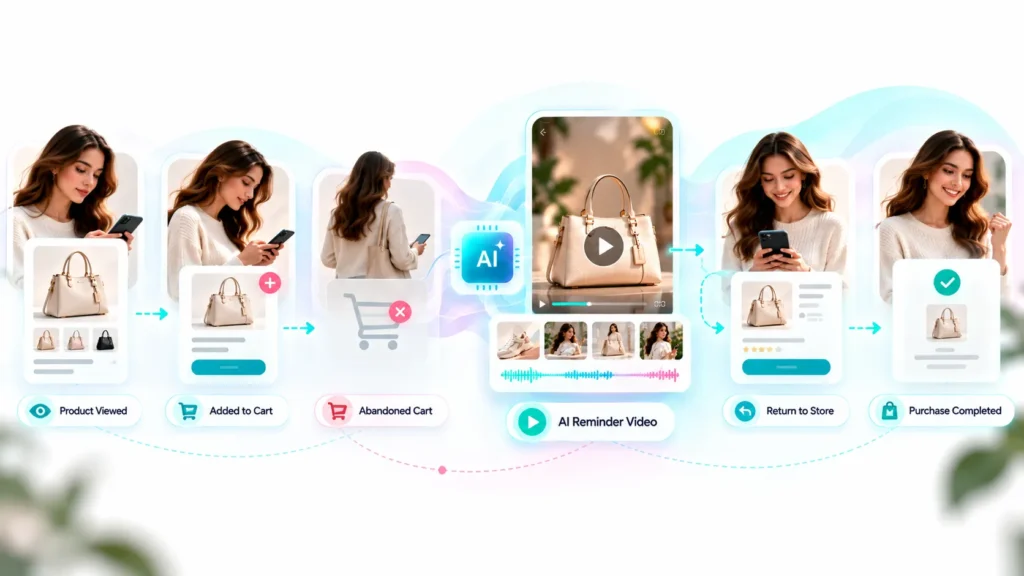
AI Videos for abandoned cart marketing give ecommerce brands a more engaging way to reconnect with shoppers who leave products in their carts without completing a purchase. A customer may become distracted, want to compare products, need more time to decide, feel uncertain about the purchase, or simply forget to return.
This happens frequently in ecommerce. For brands, the challenge is not only getting shoppers to add products to their carts. It is also finding effective ways to bring those shoppers back and give them another reason to complete the purchase.
Traditional abandoned cart emails can remind customers that they left something behind. However, ecommerce marketing is becoming increasingly visual, and a product image or simple text reminder may not always be enough to regain attention.
This is where AI Videos for Abandoned Cart Marketing can become useful. An AI-generated video can bring the product back into the customer’s attention through movement, product benefits, lifestyle presentation, social proof messaging, promotional information, or a simple reminder.
The goal is not to create a complicated video. The goal is to create a relevant visual reminder that gives the customer another reason to return to the purchase.
Why Abandoned Cart Marketing Needs More Than a Reminder
An abandoned cart represents a customer who has already shown purchase intent. They did more than visit a website. They selected a product and moved it closer to checkout. That makes an abandoned cart different from a cold marketing audience. The customer already knows something about the product. The challenge is understanding what might bring them back.
A reminder video can therefore focus on reinforcing the product rather than introducing the brand from the beginning.
For example, a fashion brand might remind the customer how the product looks when worn. A beauty brand could highlight the product’s benefits. An electronics brand could demonstrate a useful feature.
The creative should connect with the reason the customer was interested in the product in the first place.
Understanding the Abandoned Cart Customer Journey
Before creating a video, it helps to understand where the customer stopped.
A simplified ecommerce journey can look like: Product Discovery → Product Page → Add to Cart → Checkout → Purchase
Abandoned cart marketing targets the gap between Add to Cart and Purchase.
This means the customer has already crossed several stages of the buying journey.
The video should therefore avoid wasting time explaining everything about the company.
Instead, it should focus on the product and the decision that remains.
A practical message structure could be: You liked it → Here’s what makes it valuable → Here’s why it fits your needs → Come back and complete your purchase
This keeps the content relevant to the customer’s existing interest.
What Are AI Videos for Abandoned Cart Marketing?
AI videos for abandoned cart marketing are short marketing videos created or adapted using AI to re-engage customers who added products to their shopping cart but did not complete the purchase.
These videos can focus on:
- The abandoned product
- Product benefits
- Key features
- Product demonstrations
- Lifestyle presentation
- Customer use cases
- Promotions
- Limited-time offers
- Product availability
- Social proof
- Brand reassurance
The format can vary depending on the product and customer journey.
A fashion brand might use a model-based product video.
A beauty brand might use a product-focused demonstration.
An electronics brand might highlight product features.
A home brand might show the product in a lifestyle environment.
The important element is relevance.
Why Video Can Be Effective for Cart Recovery
Static reminders can show the product, but video can create a more dynamic presentation.
Movement can draw attention back to a product.
A short video can also communicate several elements within a few seconds, such as product appearance, features, use case and CTA.
For example, a product recovery video could begin with the product, move into a lifestyle presentation, highlight one important benefit and finish with a clear message encouraging the shopper to return.
This gives the customer more context without requiring a long message.
How to Create AI Videos for Abandoned Cart Marketing
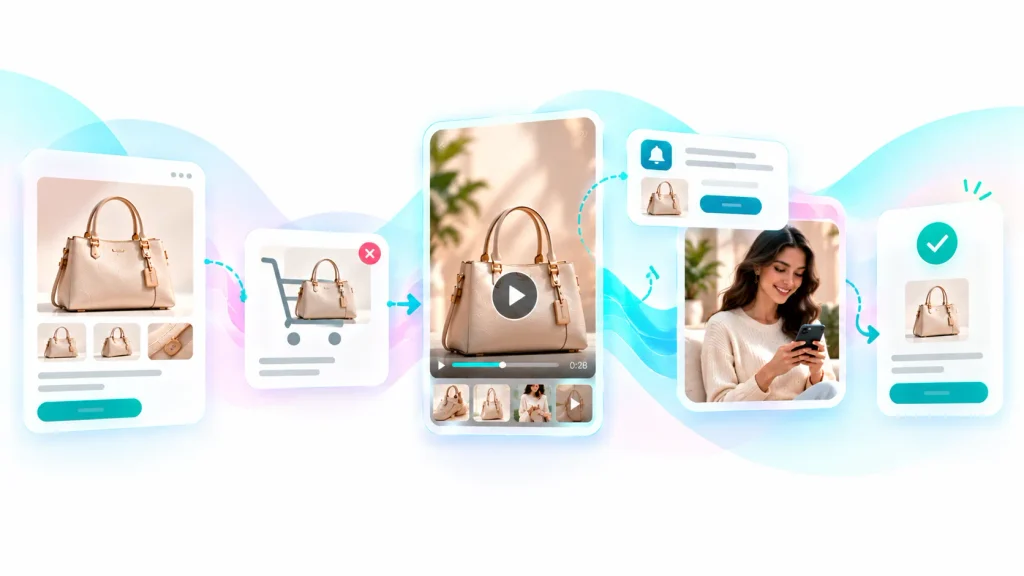
Creating effective abandoned cart videos starts with the customer journey rather than the video tool.
Start With the Abandoned Product
The product should be the central element.
Use the product image, product reference or existing product assets associated with the abandoned cart.
This ensures that the reminder connects directly to the customer’s previous shopping activity.
Identify the Reason to Return
Ask what could make the customer reconsider the purchase.
The answer may be:
- Product benefits
- Product quality
- A useful feature
- A special offer
- Free shipping
- Limited availability
- Social proof
- Product demonstration
- New information
The video should focus on one or two strong reasons rather than trying to communicate everything.
Choose the Right Video Concept
Different products require different creative approaches.
A simple product showcase may work for one product.
A lifestyle video may work better for another.
A feature demonstration may be more appropriate for electronics.
A model-based presentation may be stronger for fashion.
Choose the concept based on the product and purchase decision.
Build a Short Story
An abandoned cart video does not need to be long.
A simple structure can be:
Hook → Product → Key Benefit → Reassurance → CTA
For example:
Still thinking about it? → Show product → Highlight benefit → Reinforce value → Complete your order
The structure keeps the video focused.
Add a Clear CTA
The customer should understand what to do next.
Possible CTAs include:
- Return to your cart
- Complete your purchase
- Continue shopping
- Get yours today
- Finish your order
- Your cart is waiting
The CTA should match the campaign and customer context.
Creating Different Types of Abandoned Cart Videos
Not every abandoned cart requires the same message.
Different products and audiences may need different creative approaches.
Product Reminder Videos
The simplest approach is to remind the customer about the exact product they left behind.
Show the product clearly and reinforce its key benefit.
This works well when the customer already showed strong purchase intent and does not need extensive persuasion.
Product Benefit Videos
Sometimes the customer needs a stronger reason to purchase.
A benefit-focused video can highlight what makes the product valuable.
For example, a skincare product could focus on its core benefit, while a kitchen product could demonstrate how it saves time.
Product Demonstration Videos
Some products are easier to understand when shown in action.
A short demonstration can address uncertainty by showing how the product works.
This can be useful for:
- Electronics
- Kitchen products
- Fitness products
- Home products
- Beauty tools
- Software-related products
Lifestyle Videos
Lifestyle presentation can help customers imagine owning or using the product.
A fashion product can be shown on a model.
Furniture can be presented in a room.
Travel products can be placed into a relevant environment.
The objective is to help the shopper visualize the product in their own life.
Promotional Videos
A promotional video can include an incentive where appropriate.
This might be:
- Limited-time discount
- Free shipping
- Special offer
- Bundle benefit
- Seasonal promotion
However, businesses should avoid training customers to abandon carts simply to receive discounts.
Not every abandoned cart needs a price incentive.
Urgency-Based Videos
Some campaigns may use genuine urgency.
For example, a product may have limited availability or a promotion may have a real end date.
The urgency should be truthful.
Avoid artificial scarcity that could damage customer trust.
How to Structure the Video Story
A strong abandoned cart video can follow a simple framework.
Opening Hook
The first few seconds should immediately reconnect the customer with the product.
Examples:
- Still thinking about this one?
- Your cart is waiting.
- You left something you liked behind.
- Ready to complete your order?|
The hook should be short and relevant.
Product Presentation
Show the product clearly. Do not hide the main product behind unnecessary visual effects. The customer should immediately recognize what they were considering.
Key Benefit
Focus on the most persuasive benefit. One strong benefit is usually more useful than a long list of features.
Reassurance
Address a potential hesitation where appropriate.
This could involve:
- Product quality
- Easy returns
- Shipping
- Product durability
- Customer reviews
- Warranty
- Product support
The message should reflect genuine information available from the brand.
Call to Action
- End with a simple next step.
- Return to your cart.
- Complete your order.
- Get your product today.
The customer should not have to figure out what to do next.
Personalizing Abandoned Cart Videos
Personalization can make cart recovery content more relevant.
The most basic form of personalization is showing the product the customer abandoned.
More advanced campaigns can organize customers according to:
- Product category
- Product value
- Customer segment
- Previous purchases
- Campaign source
- Shopping behavior
- New versus returning customer
The creative can then be adapted to the audience.
For example, a returning customer may need a different message from someone purchasing from the brand for the first time.
However, personalization should remain useful rather than intrusive.
Customers should feel that the content is relevant, not that their browsing behavior is being unnecessarily exposed.
Creating AI Videos for Different Product Categories
Fashion and Apparel
Fashion abandoned cart videos can show the product on a model, demonstrate different styling options or reinforce the product’s visual appeal.
A short video can remind the shopper what attracted them to the product.
Jewellery
Jewellery requires strong visual presentation.
A recovery video can highlight the product from multiple angles, show it being worn and emphasize details such as design, finish, and styling.
Beauty and Skincare
Beauty products can benefit from videos focused on product benefits, usage and lifestyle context.
The video can remind customers why the product was relevant to their original shopping intent.
Electronics
Electronics products often require more explanation.
A short feature-focused video can demonstrate what the product does and why it may be useful.
Home and Furniture
Lifestyle videos can show furniture and home products in context.
This can help shoppers visualize how the product may fit into their environment.
Food and Beverage
Food products can use visually appealing product presentations, packaging shots, serving suggestions and promotional messaging.
D2C Products
D2C brands can use abandoned cart videos as part of broader retargeting campaigns.
The product can be presented through different creative concepts depending on the audience and campaign stage.
How Businesses Can Scale Abandoned Cart Video Production
Creating one recovery video is relatively easy.
Creating different videos for hundreds of products is the bigger challenge.
This is where AI becomes particularly useful.
Build Product-Based Video Templates
Create approved video structures for different product categories.
For example:
Fashion Template : Product → Model → Detail → Styling → CTA
Electronics Template : Product → Feature → Demonstration → Benefit → CTA
Beauty Template : Product → Texture/Presentation → Benefit → Lifestyle → CTA
These templates can be reused across multiple products.
Create Different Creative Variations
A single product can have several recovery messages.
For example: Videos can be kept in different variations as below
- Product reminder
- Benefit-focused
- Lifestyle-focused
- Promotional
- Social-proof-focused
This allows marketers to test different approaches.
Keep Videos Short and Focused
- Cart recovery is not the right place for a long brand story.
- The customer already knows the product.
- The video should quickly remind, reassure and encourage action.
Match the Video to the Customer Segment
- Different customers may require different messages.
- High-intent shoppers may only need a reminder.
- First-time customers may benefit from additional reassurance.
- Returning customers may respond better to product or collection recommendations.
Related LovPics AI Video Solutions
Businesses creating catalog-based video ads can combine multiple LovPics capabilities depending on the campaign.
- AI Product Video: Turn product images into short-form video content for ecommerce and marketing campaigns.
- Product Reels: Create catalog-clean, multi-beat product reels with hero shots, feature callouts, and CTA beats.
- UGC Product Showcase: Add a creator-led format when a product demonstration or presenter-style advertisement is more appropriate.
- Multilingual AI Reels: Adapt campaigns for audiences that speak different languages.
- AI Product Photography: Create or improve the product visuals that become the foundation for video campaigns.
- E-Commerce Pack: Generate product, model, banner, and poster assets from a product image as part of a broader ecommerce content workflow.
- AI Banner Generator: Extend the campaign from video into static advertising formats.
- AI 360° Product Views: Create additional product visualization assets that can complement video advertising.
- AI Fashion Catalog Photos: Build consistent fashion catalog imagery that can provide additional references for campaign production.
- AI Reels: Build broader social campaigns using product, UGC, jewellery, saree, multilingual, and animated reel workflows.
These capabilities can help teams build different creative formats around the same ecommerce product.
Real-World Applications
Recovering High-Value Carts
Higher-value products often require more consideration. A product-focused video can reinforce benefits and provide additional information before asking the customer to complete the purchase.
Recovering Fashion Carts
Fashion brands can remind shoppers about the garment through model imagery, styling ideas or collection context.
Recovering Seasonal Purchases
Seasonal products may require a stronger reminder because customers are shopping within a limited timeframe. A seasonal video can reinforce relevance and encourage timely action.
Recovering Product Bundles
If customers abandoned a bundle, a video can show how the products work together. This can communicate the value of purchasing the complete set.
Recovering Mobile Shoppers
Short vertical videos can work well for mobile-first remarketing environments. The creative should be designed for quick viewing and a clear CTA.
Supporting Retargeting Campaigns
Abandoned cart videos can also become part of broader retargeting strategies. Different audiences can receive different video messages depending on where they stopped in the buying journey.
Across the LovPics Ecosystem
Abandoned cart video marketing does not need to operate as an isolated content activity.
A product can begin with product photography and then become a product video, Reel, banner and retargeting creative.
A broader workflow can look like: Product Image → Product Video → Reel → Campaign Creative → Retargeting Video → Cart Recovery
This makes the original product asset more valuable.
Instead of creating separate production processes for each marketing stage, ecommerce teams can reuse product references across the customer journey.
Expand AI Videos for Abandoned Cart Marketing With LovPics
LovPics can help ecommerce teams create the visual assets needed to support product-focused video marketing workflows.
A product reference can be transformed into product videos, Reels, model-based visuals, banners and other campaign creatives.
For abandoned cart campaigns, the focus should remain on relevance.
The video should remind the shopper about the product they already considered, provide a useful reason to return, and make the next step clear.
AI can help make this process more scalable when ecommerce brands need different video concepts across large product catalogs.
The technology handles repetitive production work while marketers remain responsible for customer strategy, messaging, and campaign decisions.
Common Mistakes Businesses Make
Making the Video Too Long
An abandoned cart customer does not necessarily need a complete product presentation.
Better approach: Keep the video short and focus on the strongest reason to return.
Showing Too Many Products
A recovery video should usually focus on the product the customer abandoned.
Better approach: Keep the creative product-specific whenever possible.
Using a Generic Brand Advertisement
A generic brand video may not reconnect strongly with an abandoned product.
Better approach: Lead with the product and the customer’s existing interest.
Offering Discounts Too Quickly
If every abandoned cart receives a discount, customers may learn to wait for an incentive.
Better approach: Test reminder, benefit, and reassurance messages before relying on discounts.
Creating False Urgency
Artificial scarcity can damage customer trust.
Better approach: Use urgency only when the limitation is genuine.
Ignoring the Original Purchase Intent
A customer who abandoned a product may have had a specific reason for considering it.
Better approach: Focus the video on the product’s strongest relevant benefit.
Using Poor Product Visuals
AI-generated video cannot compensate for a weak or inaccurate product reference.
Better approach: Start with clear product imagery and review the final video carefully.
Forgetting the CTA
A visually attractive video can still fail if the customer does not know what to do next.
Better approach: End with a clear action such as returning to the cart or completing the purchase.
The Future of AI Videos for Abandoned Cart Marketing
Abandoned cart marketing is likely to become increasingly visual and personalized.
Instead of sending the same reminder to every shopper, ecommerce businesses can create different creative experiences based on product category, customer intent and campaign stage.
Abandoned cart marketing is likely to become increasingly visual and personalized as ecommerce brands look for better ways to reconnect with shoppers. Instead of sending the same reminder to every customer, businesses can create different creative experiences based on product category, customer intent, browsing behavior, and campaign stage.
AI can make it easier to generate these variations at scale while keeping the content relevant to each audience. A fashion shopper could receive a model-based reminder that showcases how the product looks when worn, while an electronics customer could receive a short video highlighting key features, specifications, or product benefits.
Similarly, a beauty shopper could receive a benefit-focused product video that demonstrates usage or highlights important product features. A furniture shopper could see the product presented in a realistic lifestyle environment, helping them understand how it could look in their home.
The future opportunity is not simply about generating more abandoned cart videos. It is about creating more relevant recovery experiences that match the customer’s interests and purchase intent. As ecommerce teams connect product data, customer segmentation, and creative production, video can become an important layer between shopping intent and completed purchase. It is creating more relevant recovery experiences.
As ecommerce teams connect product data, customer segmentation, and creative production, video can become an important layer between shopping intent and completed purchase.
Comparison Table
Traditional Abandoned Cart Marketing vs AI Video Recovery
| Area | Traditional Approach | AI Video Approach |
|---|---|---|
| Product Reminder | Text or static image | Product-focused video |
| Product Presentation | Limited movement | Dynamic visual storytelling |
| Creative Variations | More manual production | Easier to create multiple concepts |
| Product Categories | Often generic messaging | Category-specific video concepts |
| Lifestyle Presentation | Requires production | AI can support contextual visuals |
| Model Content | Requires photoshoot | AI model workflows can support imagery |
| Testing | More production effort | Multiple creative variations are easier |
| Catalog Scaling | Can become resource-heavy | More repeatable workflows |
| Mobile Content | Requires separate creative | Vertical video can be produced as a format |
| Personalization | Often message-based | Product and creative can be adapted |
Decision Matrix
| Marketing Requirement | AI Video Fit |
|---|---|
| Product-specific cart reminders | High |
| Large product catalog | High |
| Fashion cart recovery | High |
| Product benefit reminders | High |
| Feature demonstrations | High |
| Mobile retargeting | High |
| Multiple creative variations | High |
| Lifestyle product reminders | High |
| High-value product recovery | High |
| Highly complex personalized campaigns | Depends on data and workflow |
Frequently Asked Questions
What are AI videos for abandoned cart marketing?
They are short AI-assisted marketing videos designed to re-engage customers who added products to their carts but did not complete their purchases.
What should an abandoned cart video show?
The video should generally focus on the abandoned product, its strongest relevant benefit and a clear reason for the customer to return.
How long should an abandoned cart video be?
There is no universal duration, but short, focused videos are generally more suitable because the customer already knows the product and needs a reminder rather than a long introduction.
Can AI create a video from a product image?
Yes. AI video workflows can use product images or other references as inputs for product-focused video creation.
Can abandoned cart videos include discounts?
Yes, when a discount is part of the campaign strategy. However, brands should avoid automatically discounting every abandoned cart because it may encourage customers to delay purchases.
Can AI videos be personalized for different products?
Yes. Different product references and creative concepts can be used to create product-specific recovery videos.
Can fashion brands use AI videos for abandoned carts?
Yes. Fashion brands can use model-based visuals, styling concepts, and product presentations to remind shoppers about abandoned clothing and accessories.
Can AI videos work for mobile cart recovery campaigns?
Yes. Short vertical videos can be created for mobile-first marketing environments and social retargeting campaigns.
Should every abandoned cart receive the same video?
Not necessarily. Product category, customer intent, cart value, and campaign objective can influence the most appropriate creative approach.
How can LovPics help create abandoned cart videos?
LovPics can support product photography, product videos, Reels, model-based imagery, banners, and other ecommerce visual assets that can be combined into broader cart recovery campaigns.
Conclusion
Abandoned carts represent customers who have already shown meaningful purchase intent. That makes cart recovery different from ordinary awareness marketing. The goal is not to introduce the product from scratch. It is to remind the customer why they were interested, address potential hesitation, and make returning to the purchase easy.
AI Videos for Abandoned Cart Marketing can help ecommerce teams create short, product-focused visual reminders at scale.
A fashion product can become a model-based reminder. An electronics product can become a feature demonstration. A beauty product can become a benefit-focused video. A furniture product can become a lifestyle presentation.
The most effective approach is not to create complicated videos. It is to create relevant videos with a clear purpose. With strong product references, focused messaging, appropriate creative formats, and human quality control, AI can help ecommerce brands turn abandoned cart recovery into a more scalable and engaging visual marketing workflow.