Best AI Fashion Model Generator for Stunning Product Photos

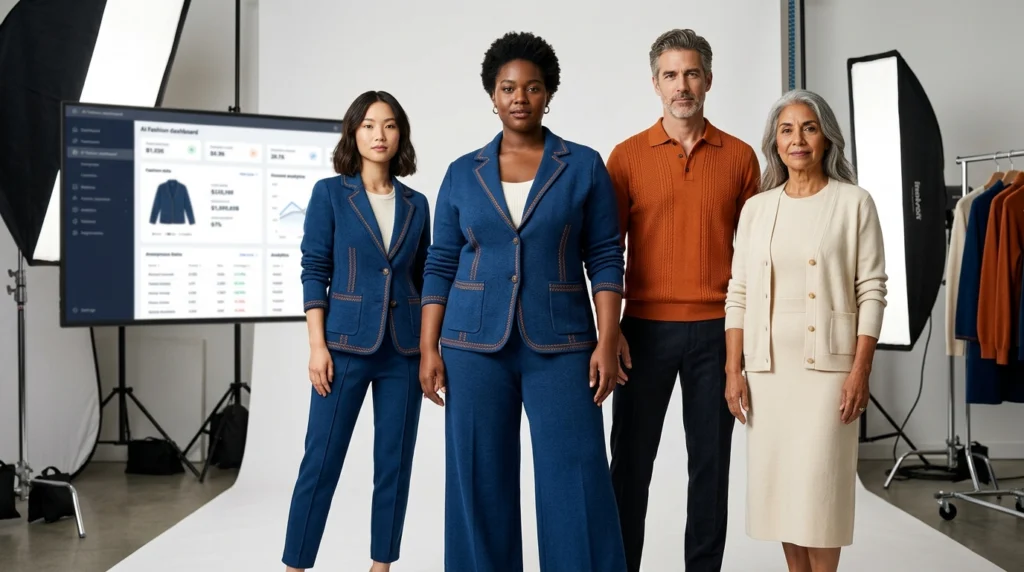
An AI fashion model generator allows fashion brands to create realistic on-model product images without organizing traditional photoshoots. Modern AI platforms can place garments on diverse virtual models representing different body types, skin tones, ages, and poses while preserving the original clothing’s color, texture, fit, and design. For ecommerce businesses, this reduces production costs, shortens campaign timelines, and makes it easier to create inclusive marketing visuals at scale.
Key Takeaways
- AI fashion model generators help brands create professional on-model images without hiring models or booking studios.
- Diverse representation is becoming an important part of modern ecommerce, making AI-generated multicultural models valuable for global brands.
- The best AI solutions preserve garment details such as fabric texture, colors, prints, and silhouettes instead of generating entirely new clothing.
- Consistent AI models allow brands to maintain the same visual identity across seasonal collections and product catalogs.
- AI supports creative teams by accelerating production, allowing them to focus on storytelling and campaign strategy rather than repetitive photoshoots.
Why Fashion Brands Are Rethinking Traditional Photoshoots
Fashion ecommerce has changed dramatically over the past decade. Consumers expect to see products from multiple angles, on different models, and in lifestyle settings before making a purchase. At the same time, marketing teams are expected to launch collections faster than ever.
- This creates a difficult balance.
- Brands need more images.
- More campaigns.
- More model diversity.
- More localized marketing.
- And shorter production timelines.
Traditional photoshoots were never designed for this level of demand.
Every campaign requires:
- Model selection
- Studio bookings
- Photography equipment
- Stylists
- Makeup artists
- Creative direction
- Post-production
- Retouching
Repeating this process for every new collection quickly becomes expensive and time-consuming. As product catalogs continue to grow, scaling traditional photography becomes increasingly difficult.
The Growing Demand for Diverse Fashion Representation
Fashion is global. Your customers are not all the same age. They don’t share the same body type. They don’t have identical skin tones. Nor do they all live in the same country. Modern shoppers increasingly expect brands to represent people who look like them.
This shift isn’t simply about inclusion. It’s also about helping customers imagine how products might look on someone with similar characteristics.
Showing garments on a wider variety of models creates a more relatable shopping experience and helps brands connect with broader audiences.
For international ecommerce businesses, diversity is no longer optional. It has become part of building trust across different markets.
The Hidden Cost of Traditional Fashion Photography
When brands evaluate photography costs, they often think only about the studio session. However, the visible photoshoot is only one part of the total investment.
Behind every campaign are additional costs that accumulate over time:
- Finding suitable models
- Coordinating schedules
- Shipping samples
- Travel expenses
- Studio rental
- Creative direction
- Image selection
- Editing and retouching
- Reshoots
- Delays caused by weather or logistics
Now multiply those activities across dozens or even hundreds of products. For growing fashion brands, production quickly becomes one of the largest operational bottlenecks. The challenge isn’t taking one great photograph. It’s producing thousands of consistent, high-quality product images every season.
What Is an AI Fashion Model Generator?
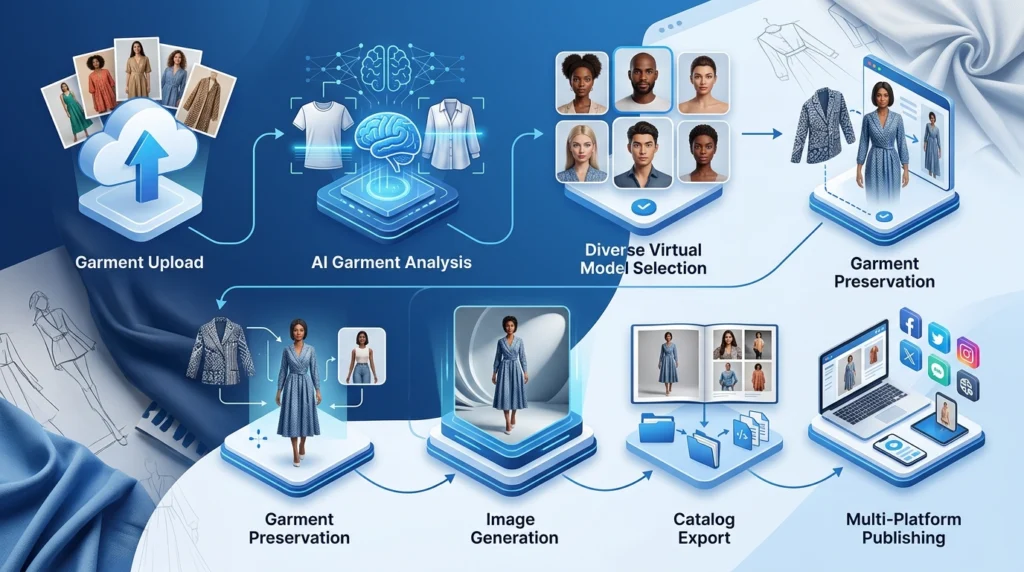
An AI fashion model generator uses artificial intelligence to create realistic on-model images from existing product or garment photos.
Instead of photographing every garment on multiple human models, brands upload their apparel images and choose characteristics such as:
- Body type
- Skin tone
- Age group
- Gender presentation
- Hairstyle
- Pose
- Facial expression
- Background style
The AI then generates professional-looking fashion imagery while keeping the clothing visually accurate.
Unlike generic AI image generators, ecommerce-focused fashion AI is designed to preserve important garment details including:
- Fabric texture
- Stitching
- Prints
- Logos
- Colors
- Sleeve length
- Product fit
- Overall silhouette
For apparel brands, this distinction is essential because customers expect product images to accurately represent what they will receive.
What Makes the Best AI Fashion Model Generator?
Not every AI image generator is suitable for fashion e-commerce. The best platforms are designed specifically to solve the challenges faced by clothing brands.
Here are the qualities that matter most.
1. Garment Accuracy
The clothing should remain true to the original product. Changes to colors, prints, textures, or construction can reduce customer trust and create unrealistic expectations. A high-quality AI fashion model generator prioritizes garment fidelity over artistic interpretation.
2. Diverse Model Library
Fashion brands serve different audiences. The ability to generate models across various:
- Body types
- Skin tones
- Ages
- Ethnic backgrounds
- Hair styles
- Poses
allows businesses to create campaigns that better represent their customers.
3. Consistent AI Fashion Models
One common challenge with generic AI tools is inconsistency. The same prompt may generate a completely different model each time. For e-commerce catalogs, consistency matters. Using the same AI model across an entire collection creates a more cohesive brand experience and strengthens visual identity.
4. Scalable Production
The right platform should support growth. Whether you’re producing 20 product images or 20,000, the workflow should remain efficient. Automation becomes increasingly valuable as product catalogs expand.
Introducing the DIVERSE Framework™
Choosing an AI fashion model generator isn’t just about creating attractive images. It’s about building a scalable visual merchandising strategy. At LovPics, we use the DIVERSE Framework™ to evaluate AI-powered fashion photography.
D – Discover Your Audience
Understand who your customers are before selecting models. Representation should reflect your actual market, not assumptions.
I – Include Authentic Representation
Show products on models with different appearances, ages, and body types to create a more inclusive shopping experience.
V – Visualize Garments Accurately
Clothing accuracy is more important than artistic effects. Customers should recognize the same garment they receive after purchase.
E – Expand Across Markets
As brands grow internationally, AI makes it easier to create localized visuals for different regions without organizing separate photoshoots.
R – Reuse Consistent Models
Maintaining the same AI model across collections strengthens brand recognition and creates cohesive lookbooks.
S – Scale Creative Production
AI enables teams to create significantly more marketing assets without proportionally increasing production effort.
E – Enhance Customer Confidence
Clear, accurate, and diverse product visuals help shoppers make more informed purchasing decisions.
Read Previous Article on AI Fashion Studio
Why Fashion Ecommerce Is Moving Toward AI-Assisted Photography
AI is not replacing fashion photography. It is changing how brands approach repetitive production work. Traditional photography will always have a place for hero campaigns, editorial shoots, and luxury brand storytelling.
However, ecommerce catalogs, seasonal launches, marketplace listings, and marketing campaigns often require speed, consistency, and scale. This is where AI provides the greatest value.
Instead of replacing creative teams, AI allows photographers, designers, and marketers to spend less time repeating production tasks and more time creating experiences that differentiate their brand.
AI Fashion Model Generator vs Traditional Fashion Photoshoots
Artificial intelligence has introduced a new way to create fashion imagery, but it hasn’t eliminated the need for traditional photography.
Each approach serves a different purpose.
Understanding those differences helps brands choose the right workflow instead of assuming one solution replaces the other.
| Factor | Traditional Photoshoot | AI Fashion Model Generator |
|---|---|---|
| Setup Time | Days or weeks | Minutes |
| Cost | High | Significantly lower for large catalogs |
| Model Diversity | Limited by availability | Wide range of body types, ages, and skin tones |
| Garment Accuracy | Excellent | High when using ecommerce-focused AI |
| Scalability | Limited | Designed for bulk production |
| Catalog Updates | Slow | Fast |
| Best Use Case | Editorial campaigns, luxury launches | Ecommerce catalogs, marketplaces, marketing campaigns |
Traditional photoshoots remain valuable for flagship campaigns, luxury editorials, and brand storytelling where complete creative control is essential.
AI fashion model generators excel when brands need hundreds or even thousands of consistent product images within tight deadlines.
For many businesses, the most effective strategy combines both approaches. Use traditional photography for hero campaigns. Use AI to scale everyday ecommerce production.
Real-World Use Cases
1. Ecommerce Product Catalogs
Fashion retailers frequently launch new collections containing dozens or even hundreds of products. Instead of organizing separate photoshoots for every release, AI can generate consistent on-model images while preserving the garment’s appearance. This significantly accelerates catalog production.
2. Marketplace Listings
Marketplaces require large numbers of product images that meet specific formatting requirements. AI-generated fashion models allow brands to create multiple listing variations without repeating the entire photography process.
3. International Marketing
A campaign targeting customers in Europe may benefit from different model representation than one designed for Southeast Asia or North America. AI enables brands to localize campaigns while maintaining consistent product presentation.
4. Seasonal Collections
Fashion trends evolve quickly. Brands launching Spring, Summer, Autumn, and Winter collections need fresh creative assets throughout the year. AI allows existing garments to appear in new campaign environments without scheduling additional photoshoots.
5. Social Media Campaigns
Content demand on Instagram, Pinterest, TikTok, and Facebook continues to increase. Instead of producing one hero image, brands often need dozens of creative variations. AI makes this production process far more manageable.
Why Multicultural Representation Matters
Modern e-commerce serves a global audience. Customers want to see products presented by people they can relate to. Representation goes beyond appearance. It influences trust, product perception, and purchase confidence.
An AI fashion model generator makes it practical to create visuals featuring diverse:
- Skin tones
- Body shapes
- Age groups
- Hairstyles
- Facial features
- Cultural styling preferences
This allows brands to develop campaigns that feel more relevant to different customer segments without organizing separate photoshoots for every market.
Worked Example
Illustrative Scenario
Imagine an online clothing retailer preparing to launch a new collection of 250 products. The marketing team plans to promote the collection through:
- Ecommerce product pages
- Facebook Ads
- Email campaigns
- Marketplace listings
- Seasonal lookbooks
Using a traditional workflow, every new campaign would require additional planning, model coordination, photography, editing, and approval. Instead, the team photographs each garment once and uses an AI fashion model generator to produce multiple on-model variations.
For every product, they create:
- A lifestyle image
- A clean ecommerce product image
- A multicultural campaign version
- A marketplace version
- A social media creative
The garments remain visually accurate, while the creative adapts for different audiences and marketing channels. The result is a scalable workflow that supports ongoing campaigns without repeatedly organizing new photoshoots.
Fashion Model Selection Matrix
| Business Goal | Recommended AI Capability |
|---|---|
| Inclusive Marketing | Diverse body types and skin tones |
| Premium Fashion Brand | Consistent reusable AI models |
| Marketplace Listings | Accurate garment preservation |
| Global Campaigns | Multicultural model generation |
| Product Catalogs | Bulk image generation |
| Social Media Marketing | Lifestyle poses and creative backgrounds |
Rather than selecting AI based on image quality alone, brands should evaluate how well the platform supports their long-term production workflow.
Common Mistakes When Choosing an AI Fashion Model Generator
Choosing Image Quality Over Garment Accuracy
Beautiful images are meaningless if the clothing changes during generation. Fashion ecommerce depends on accurate product representation.
Ignoring Brand Consistency
Generating a different model for every product creates an inconsistent catalog. Whenever possible, maintain the same AI model across a collection.
Forgetting Global Audiences
Brands expanding internationally should think beyond one default model.
Localized representation helps campaigns feel more relevant to different customer groups.
Treating AI as a Replacement for Creativity
AI accelerates production.
Creative direction, brand storytelling, styling, and merchandising still require human expertise.
The best results come from combining both.
Why LovPics Stands Out
Many AI image generators are built for general creative experimentation. Fashion ecommerce has very different requirements. LovPics is designed specifically for commercial fashion production.
It focuses on preserving garment accuracy while giving brands control over:
- Body type
- Skin tone
- Age
- Pose
- Consistent AI models
- Custom model uploads
- High-resolution exports
- Bulk image generation
Instead of generating random fashion images, LovPics helps businesses create reliable, production-ready visuals suitable for ecommerce websites, marketplaces, advertising campaigns, and product catalogs.
Frequently Asked Questions
What is the best AI fashion model generator?
The best AI fashion model generator depends on your business goals. Ecommerce brands should prioritize garment accuracy, diverse model options, consistency across collections, and scalable production rather than image generation alone.
Can AI preserve my clothing accurately?
Yes. Ecommerce-focused AI platforms are designed to preserve important garment details such as fabric texture, color, patterns, logos, and overall fit while placing the clothing on virtual models.
Can I generate multicultural AI fashion models?
Yes. Modern AI platforms allow brands to create on-model imagery representing different skin tones, body types, ages, and appearances, making it easier to support global marketing campaigns.
Can I use the same AI model across multiple products?
Yes. Maintaining a consistent virtual model across an entire collection creates a more cohesive catalog and strengthens brand identity.
Is AI fashion photography suitable for small businesses?
Absolutely. Smaller brands often benefit the most because AI reduces the cost and complexity of organizing traditional fashion photoshoots while enabling professional product presentation.
Conclusion
Fashion ecommerce is becoming more visual, more global, and more demanding every year. Customers expect accurate product imagery, authentic representation, and consistent brand experiences across every channel. Meeting those expectations through traditional photography alone can be difficult as product catalogs and campaign requirements continue to grow.
AI fashion model generators provide a practical way to expand creative production while maintaining garment accuracy and supporting diverse customer representation. Rather than replacing photographers or creative teams, AI becomes part of a modern production workflow helping brands launch collections faster, localize campaigns more efficiently, and create professional on-model imagery at scale.
For fashion businesses looking to balance quality, speed, and scalability, choosing an ecommerce-focused platform like LovPics can make it easier to build consistent product catalogs and marketing campaigns without the limitations of traditional photoshoots.
Recent from Our Blog
Stay ahead with the latest in AI-powered commerce visuals.
Reference-Based Banner Creation: Create Brand-Consistent Banners with AI
GIF Speed Control: How Animation Timing Improves e-commerce Engagement
Do You Need a Product Photographer for Your Ecommerce Store? AI vs Traditional Photography Explained
Multi-Frame 360 Generation: Create Interactive Product Views with AI
